Step Inside
Your Music

BSA is the first audio format that lets every instrument have its own speaker. Patent filed April 29, 2026. One song. Many stems. True spatial sound.

▶ Listen Now Learn More
The Inspiration

Why Does Live Music
Sound So Alive?

You're in a small club. The bass is coming from one corner. The guitar from another. The drums are raw and present behind the singer. Every instrument has its own space, its own air. You feel it.

Then you go home and play the same song on your stereo. Everything is flattened into two speakers. The magic is gone.

That gap — between the aliveness of a live performance and the flatness of a recording — is what Beyond Stereo was built to close.

BSA separates the instruments back out and gives each one its own speaker — just like the stage. It's not surround sound. It's not spatial audio. It's the physics of live music, recreated in your room.

Listen

Listen to the Beyond Stereo Story

The Problem

The Audio Format Hasn't
Changed Since 1958

A stem is an individual audio component of a song — the vocals, drums, bass, guitar, piano — each as a separate track. Think of it as layers in Photoshop, but for audio.

Stereo sounds great — and we've spent 67 years perfecting it. But every instrument still comes from the same two points in space.

BSA lets each instrument have its own place in the room. Once you hear it, stereo sounds flat.

5.1 Surround

A cake cut into 6 slices — more pieces, but each slice has all the ingredients mixed together.

Dolby Atmos

A cake on a rotating platform — it moves around you, but it's still the same cake.

BSA

Getting the flour, eggs, sugar, butter, and frosting separately — taste each ingredient, remix the recipe, or bake the exact same cake.

How BSA Works

From Stereo Mix to
Spatial Experience

Any Song

Start with any stereo recording — MP3, FLAC, streaming

AI Separation

AI splits the song into individual instrument stems

BSA Format

Stems + metadata + residual packaged in one file

Spatial Playback

Each instrument routed to its own speaker

Vocals Drums Bass Guitar Piano Strings Other
See the full BSA value chain →
Transformative Vision

The Format for the Next 67 Years

Artists publish in BSA. Live shows captured in BSA. The same file flows from the studio to the stage, to streaming, to every speaker, headphone, and screen.

Studio

Artists Publish in BSA

Sessions export stems directly into BSA. Every instrument keeps its own lane for remixing, licensing, and playback.

Stage

Live Shows Captured Once

Record concerts in BSA so fans can replay the exact venue mix later — every cone mapped to the original PA.

Streaming

Stem-Native Catalogs

Platforms deliver BSA tiers. Listeners solo, mute, and personalize without compromising the original master.

Home + Mobile

BSA Equipment Everywhere

Modular speakers, theater installs, multi-driver headphones, and earbuds that auto-discover stems and self-assign roles.

Film & TV

BSA for Picture

Concert films, sports, and cinema adopt BSA so audiences control the mix — dialogue, score, crowd — in real time.

BSA CIP filed April 29, 2026. v1.0 specification and reference SDKs publish as soon as the filing clears.

BSA vs The World

Why Not Just Use
Dolby Atmos?

5.1 and Atmos tell speakers WHERE sound goes. BSA tells speakers WHAT instrument to play.

Feature 5.1 Surround Dolby Atmos BSA
Multi-channel spatial audio?✓ Fixed channels✓ Object-based✓ Stem-based
Immersive listening experience?
Supported by major platforms?✓ Widespread✓ Apple, Amazon, TidalEmerging
Separate individual instruments?
User can remix / solo / mute?
Works with any existing song?✗ Needs remix✗ Needs remix✓ AI separation
Perfect original reconstruction?✓ Residual vector
Per-instrument hardware routing?
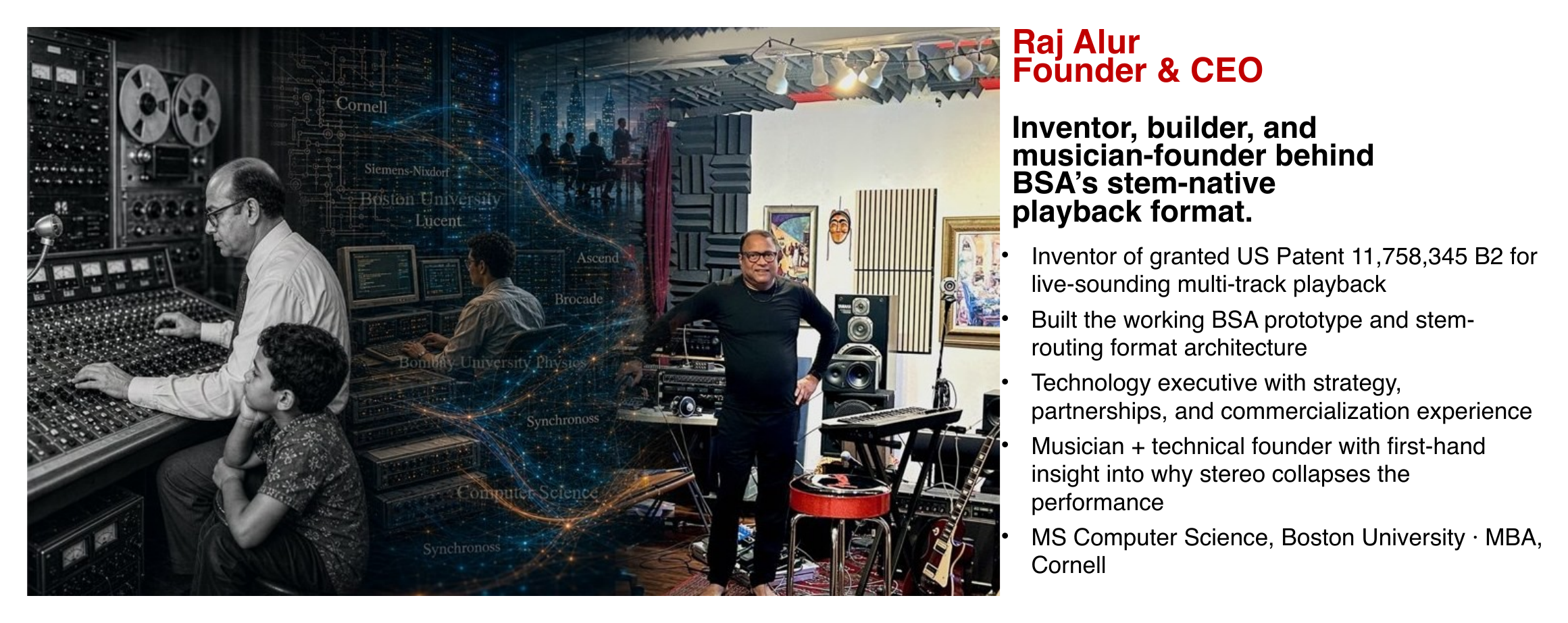
Granted patent?✓ Dolby✓ US 11,758,345 B2
Listener Validation

The Reaction is Immediate

"It sounds like the band is in the room."

In every listening test — with musicians, engineers, and casual listeners — the preference for BSA spatial playback over traditional stereo is universal. People hear it and immediately get it. No explanation needed.

Get In Touch

Want to learn more about Beyond Stereo?

Contact Us